

This historic moment was also broadcast live by the Japan Aerospace Exploration Agency (JAXA), attended by the Director General of the Ministry of Higher Education, Datin Dr. Siti Hamisah Tapsir, and UiTM's Deputy Vice Chancellor (Academic), Prof. Dr. Mohd Kamal Harun at the Faculty of Electrical Engineering, Universiti Teknologi MARA Shah Alam. According to Datin Dr. Siti Hamisah, this achievement makes UiTM the first university in Malaysia to place a nanosatellite developed by its own students into space.

Datin Dr. Siti Hamisah (left) attended the live broadcast of the UiTMSAT-1 Nano Satellite release into orbit at the Dataran Kompleks Kejuruteraan Tuanku Abdul Halim Muadzam Shah, Universiti Teknologi MARA (UiTM), Shah Alam on 10 August 2018 at exactly 5:45 p.m. Photo credit Harian Metro

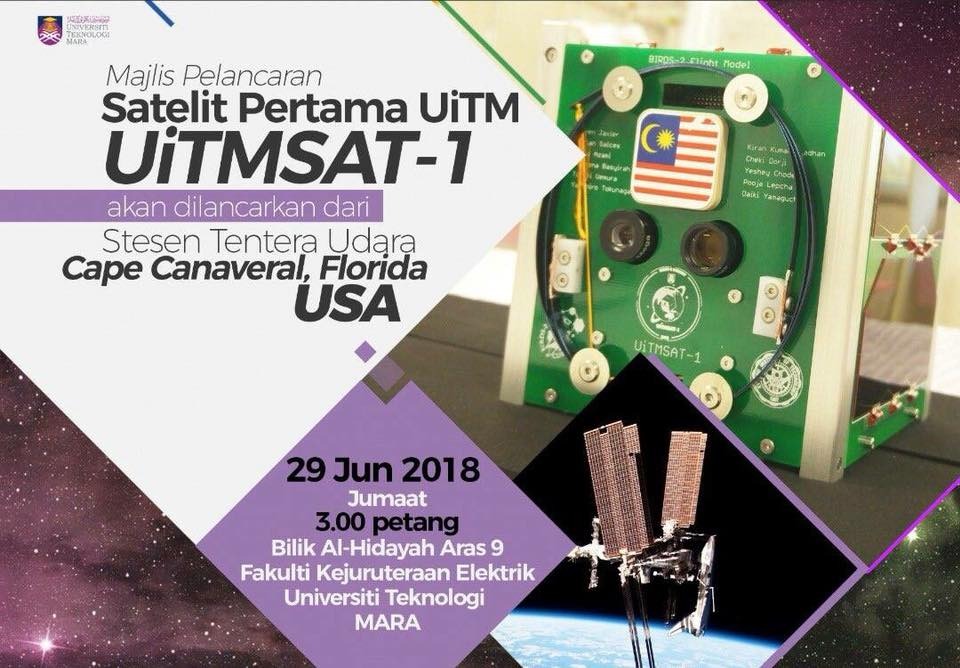
UiTMSAT-1 is the first nanosatellite from a Malaysian university, launched to the International Space Station on 29 June 2018, making it the nation’s first nano satellite successfully sent to space. UiTMSAT-1 was produced under the BIRDS-2 joint global multi-nation collaboration with Bhutan and the Philippines, led by Kyushu Institute of Technology (KyuTech), Japan. Two Malaysian postgraduate students from UiTM (Syazana Basyirah binti Mohammad Zaki and Muhammad Hasif bin Azami) were among the 11 students participating in the BIRDS-2 collaboration. They were responsible for realizing the construction and launch of the three BIRDS-2 nanosatellites: UiTMSAT-1, BHUTAN-1 (for Bhutan) and MAYA-1 (for the Philippines).
The research and development planning for UiTMSAT-1 began in January 2016 and officially commenced in November 2016 by joining the BIRDS-2 collaborative project with Japan, the Philippines and Bhutan for the construction of nanosatellites. The construction of the UiTMSAT-1 satellite together with BHUTAN-1 and MAYA-1 was completed in April 2018 and successfully launched to the ISS on 29 June 2018.

Delegation from Universiti Teknologi MARA (UiTM), (from left) UiTM student Muhammad Hasif bin Azami, Deputy Vice Chancellor (Academic & International) Prof. Ts. Dr Haji Mohamad Kamal Haji Harun, Prof. Mengu Cho (BIRDS-2 Project Director), Lead Advisor of the ASEAN Nanosatellite Project (ASEANSAT), Prof. Ir. Ts. Dr. Mohammad Huzaimy Jusoh, and Syazana Basyirah binti Mohammad Zaki.
DEVELOPMENT
The project was conducted entirely at Kyushu Institute of Technology, Japan. UiTMSAT-1 was built entirely by the two students under close supervision from lecturers and researchers from Japan, Malaysia and the Philippines. UiTMSAT-1 developed in this project is 1U in size, measuring 10cm x 10cm x 10cm and cubic in shape. The estimated weight of UiTMSAT-1 is 1 kg. It was launched into Low Earth Orbit (LEO), at altitudes between 350 km–600 km above Earth.

UiTMSAT-1, together with two other nanosatellites, had to be launched to the ISS before being released into space on 10 August 2018 at an orbital altitude of approximately 400 km from Earth. These nanosatellites orbit the Earth at a speed of around 28,000 km/h, taking only 90 minutes to complete one orbit of the planet.
A full-scale prototype of the UiTMSAT-1 nanosatellite is now exhibited at the Tun Abdul Razak Gallery, UiTM Shah Alam. In 2025, UiTM again made history with the Launch of UiTMSAT-2 to the International Space Station (ISS) on 26 October 2025.
Sources :
- Official Website https://birds2.birds-project.com/
- BHUTAN-1, Bhutan's first space borne satellite deployed from ISS on 10 August." (10 August 2018). The Bhutanese.
- UiTMSAT-1 puts Malaysia at the final frontier. (17 July 2018). New Straits Times.
- CubeSats from Malaysia, Bhutan & the Philippines deployed from the ISS." (15 August 2018). SpaceTech Asia.
- Coverage of UiTMSAT-1 – The Nation's First Nano-Satellite [11 August 2018] https://www.youtube.com/watch?v=ujglVlfSIpM
Detik bersejarah ini turut disaksikan secara langsung melalui siaran Japan Aerospace Exploration Agency (JAXA), dengan kehadiran Ketua Pengarah Kementerian Pendidikan Tinggi, Datin Dr. Siti Hamisah Tapsir serta Timbalan Naib Canselor Akademik UiTM, Prof. Dr. Mohd Kamal Harun di Fakulti Kejuruteraan Elektrik, Universiti Teknologi MARA Shah Alam. Menurut Datin Dr. Siti Hamisah, pencapaian ini menjadikan UiTM universiti pertama di Malaysia yang berjaya menempatkan nano-satelit hasil penyelidikan penuntutnya sendiri.
Datin Dr. Siti Hamisah (kiri) hadir menyaksikan majlis Siaran Langsung Pelepasan Satelit Nano UiTMSAT-1 ke Orbit di Dataran Kompleks Kejuruteraan Tuanku Abdul Halim Muadzam Shah, Universiti Teknologi MARA (UiTM), Shah Alam pada 10 Ogos 2018, tepat jam 5.45 petang. Kredit foto Harian Metro
UiTMSAT-1, adalah nanosatelit yang pertama bagi universiti di Malaysia yang dilancarkan pada 29 Jun 2018 ke Stesen Angkasa Antarabangsa (International Space Station), sekaligus menjadikan UiTMSAT-1 sebagai satelit nano pertama negara yang berjaya dilancarkan ke angkasa lepas. UiTMSAT-1 adalah hasil produk daripada projek Kerjasama BIRDS-2 (Joint Global Multi-Nation) dengan Bhutan dan Filipina yang diterajui oleh Kyushu Institute of Technology (KyuTech), Jepun. Dua orang pelajar pascasiswazah Malaysia (daripada UiTM iaitu Syazana Basyirah binti Mohammad Zaki dan Muhammad Hasif bin Azami) merupakan antara 11 orang pelajar yang menjadi ahli kerjasama BIRDS-2 ini. Mereka adalah pelajar yang bertanggungjawab dalam merealisasikan pembinaan dan pelancaran tiga buah nano-satelit BIRDS-2 iaitu UiTMSAT-1, BHUTAN-1, (bagi negara Bhutan) dan MAYA-1 (bagi negara Filipina).
Perancangan projek penyelidikan dan pembangunan UiTMSAT-1 bermula sejak Januari 2016 dan secara rasminya bermula pada November 2016 dengan menyertai projek kerjasama pintar BIRDS-2 bersama dengan negara Jepun, Filipina, dan Bhutan untuk pembinaan satelit nano. pembinaan satelit nano UiTMSAT-1 bersama-sama dengan BHUTAN-1, dan MAYA-1 telah siap pada April 2018 dan berjaya dilancarkan ke ISS pada 29 Jun 2018.
Delegasi Universiti Teknologi MARA (UiTM), (dari kiri) Pelajar UiTM, Muhammad Hasif bin Azami, Timbalan Naib Canselor (Akademik dan Antarabangsa) Prof. Ts. Dr Haji Mohamad Kamal Haji Harun, Prof. Mengu Cho (Pengarah Projek BIRDS-2), Penasihat Utama Projek Nanosatelit ASEAN (ASEANSAT), Prof. Ir. Ts. Dr. Mohammad Huzaimy Jusoh, dan Syazana Basyirah binti Mohammad Zaki.
PEMBANGUNAN
Projek ini dijalankan sepenuhnya di Kyushu Institute of Technology, Jepun. UiTMSAT-1 yang dibina sepenuhnya oleh 2 orang pelajar ini di bawah seliaan rapi oleh pensyarah dan penyelidik dari Jepun, Malaysia dan Filipina. UiTMSAT-1 yang telah dibangunkan di dalam projek ini adalah bersaiz 1U, iaitu 10cm x 10cm x 10cm dan berbentuk kubik. Anggaran berat UiTMSAT-1 adalah 1kg. Ia dilancarkan di Orbit Rendah Bumi (Low Earth Orbit), di ketinggian antara 350km-600km daripada Bumi.
UiTMSAT-1 bersama dengan 2 satelit nano yang lain perlu dilancarkan ke ISS sebelum dilepaskan ke ruang angkasa pada 10 Ogos 2018 pada ketinggian orbit sekitar 400km dari Bumi. Satelit nano ini akan mengorbit bumi dengan kelajuan sekitar 28,000km/j, yang mengambil masa 90 minit sahaja untuk melengkapkan 1 putaran bumi.
Prototaip dengan saiz sebenar satelit nano UiTMSAT-1 kini dipamerkan di Galeri Tun Abdul Razak, UiTM Shah Alam. Pada tahun 2025, UiTM mencipta sejarah dengan Pelancaran Satelit UiTMSAT-2 ke Stesen Angkasa Antarabangsa (ISS) pada 26 Oktober 2025.
Sumber :
- Laman Web Rasmi https://birds2.birds-project.com/
- BHUTAN-1, Bhutan's first space borne satellite deployed from ISS on 10 August." (10 Ogos 2018). The Bhutanese.
- UiTMSAT-1 puts Malaysia at the final frontier. (17 Julai 2018). New Straits Times.
- CubeSats from Malaysia, Bhutan & the Philippines deployed from the ISS." (15 Ogos 2018). SpaceTech Asia.
- Liputan berita UiTMSAT-1 – Nano-Satelit Pertama Negara [11 Ogos 2018] https://www.youtube.com/watch?v=ujglVlfSIpM
Liputan berita Harian Metro - UiTMSAT-1 dilancar ke orbit https://www.hmetro.com.my/mutakhir/2018/08/366887/uitmsat-1-dilancar-ke-orbit